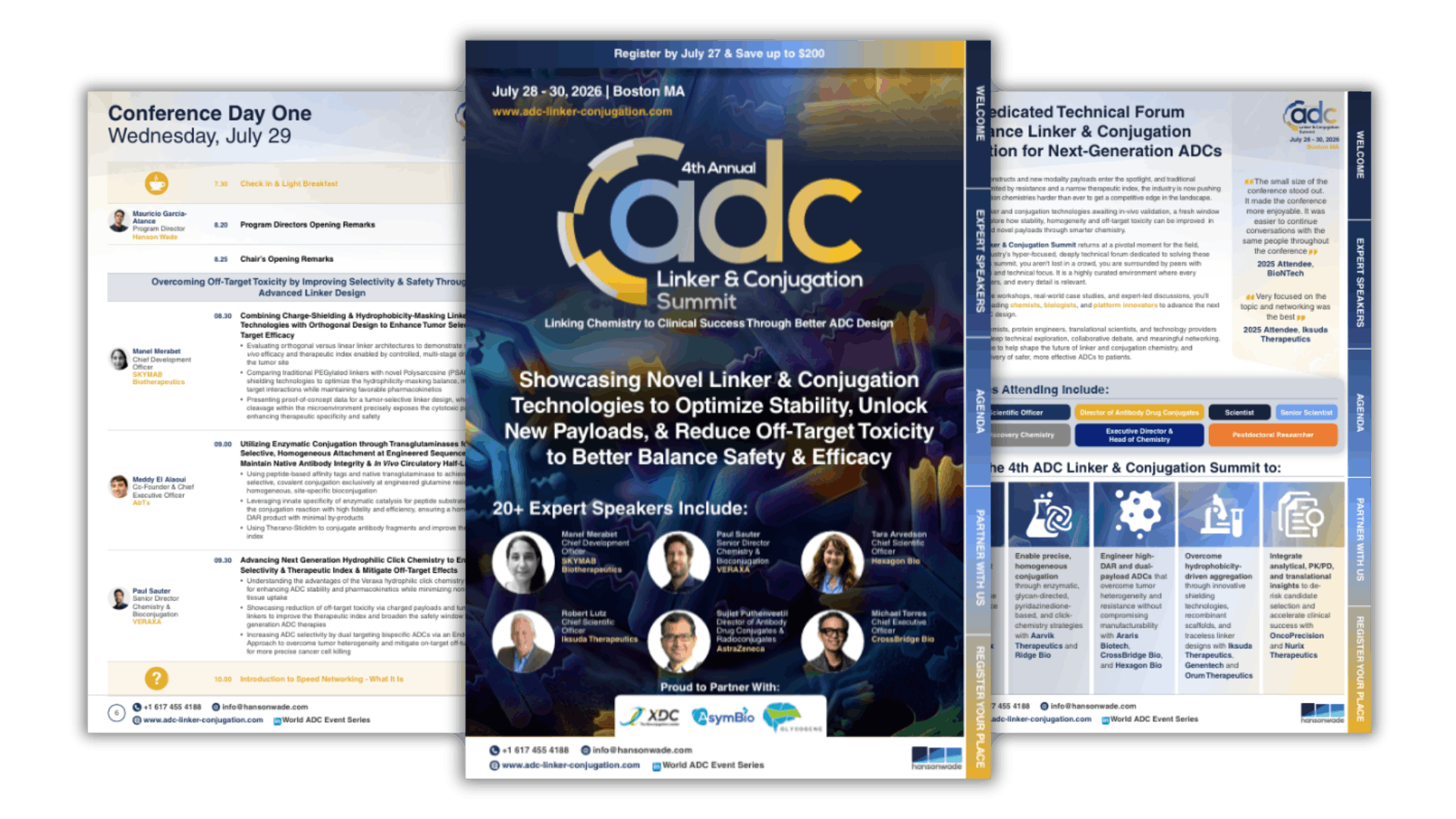

The antibody-drug conjugate (ADC) linker and conjugation industry is entering a pivotal stage of evolution. While ADCs have become one of the fastest-growing modalities in oncology, researchers across pharma, biotech, and academia increasingly agree that the next wave of innovation will depend less on payload potency and more on solving critical linker and conjugation challenges.
Balancing Linker Stability & Payload Release
One of the biggest issues facing the industry is balancing linker stability with effective payload release. Researchers highlighted the difficulty of designing linkers that remain stable in circulation while still releasing the payload efficiently once inside the tumor. If a linker is too unstable, toxic payloads can be released systemically, leading to off-target toxicities and safety concerns such as interstitial lung disease (ILD). However, overly stable linkers may reduce efficacy by limiting payload release within cancer cells. This balancing act has become one of the defining scientific debates in ADC development.
Industry Shift Toward Site-Specific Conjugation
Another major challenge is the industry’s slow transition toward site-specific conjugation. Traditional stochastic conjugation methods still dominate many approved ADCs, despite growing concerns around heterogeneous drug-to-antibody ratios (DAR), aggregation, and inconsistent pharmacokinetics. Researchers emphasized that next-generation ADCs will require far greater control over conjugation chemistry to achieve homogeneous products with predictable efficacy and safety profiles. Site-specific conjugation, disulfide bridging, enzymatic conjugation, and click chemistry are all gaining traction, but many developers believe the field still lacks sufficient comparative clinical validation.
Pressure from Emerging ADC Architectures
At the same time, the rapid emergence of dual-payload ADCs, bispecific ADCs, and degrader payloads is placing enormous pressure on existing linker technologies. Many traditional linker systems were not designed to support highly hydrophobic or structurally complex payloads. Researchers repeatedly pointed to the need for more hydrophilic, adaptable, and payload-compatible linker systems capable of supporting increasingly sophisticated ADC architectures.
Translational & Clinical Challenges
Beyond chemistry, translational understanding remains a significant hurdle. Industry leaders highlighted the lack of rigorous PK/PD analysis, predictive biomarkers, and clinically translatable models capable of accurately predicting therapeutic index and toxicity in humans.
Looking Ahead: The Role of Linker & Conjugation Innovation
As the ADC field matures, success will increasingly depend on technologies that can demonstrate not only elegant chemistry, but also clear clinical differentiation, manufacturability, and real-world therapeutic benefit.
Addressing the Challenges at the ADC Linker & Conjugation Summit
The 4th ADC Linker & Conjugation Summit will brought together leaders across pharma, biotech, academia, and solution providers to address these emerging industry challenges. With sessions focused on linker stability, site-specific conjugation, dual-payload ADCs, and translational safety, the meeting accelerated collaboration and showcased the technologies shaping the next generation of ADC development.
Written by Mauricio Garcia-Atance, Conference Producer at Hanson Wade
Explore the 2026 Event Guide
The 4th ADC Linker & Conjugation Summit was the only dedicated platform focused solely on solving the chemistry challenges underpinning next-generation ADC design.
Highlights Included:
- 20+ expert speakers from leading big pharma and biotech organizations advancing linker and conjugation innovation
- Actionable, technical insights into site-specific, enzymatic, glycan-directed, click-chemistry, and pyridazinedione-based conjugation strategies
- Case studies on dual-payload ADCs, high-DAR constructs, degrader-antibody conjugates, and orthogonal conjugation platforms
- 2 interactive pre-conference workshops bridging chemistry with PK/PD and translational performance